Havklo SDK
Production-grade Rust SDK for Kraken WebSocket API with sub-nanosecond orderbook lookups, WASM browser support, and automatic state management.
- 0 Raised
- 867 Views
- 0 Judges
Categories
Gallery



Description
Havklo SDK
The Problem I Solved
If you've ever tried to build a trading application on top of Kraken's WebSocket API, you know the pain. You subscribe to orderbook updates, deltas start flooding in at hundreds per second, and suddenly you're asking yourself: "Is my local orderbook even correct anymore?" Most implementations just trust the data and hope for the best. That's terrifying when real money is on the line.
Existing solutions fall into two camps: JavaScript libraries that are easy to use but hemorrhage performance when markets get volatile, or low-level C/C++ implementations that are fast but require a PhD to integrate. I wanted something different—a SDK that's genuinely fast, validates every single update cryptographically, and doesn't require you to rewrite your entire stack to use it.
Havklo is what I built.
What Havklo Actually Is
Havklo is a production-grade Rust SDK for Kraken's WebSocket APIs. It handles orderbook management, real-time market data streaming, authenticated trading operations, and it does all of this with performance characteristics that border on absurd.
Core benchmarks:
Best bid/ask lookup: 1 nanosecond
Spread calculation: 3.5 nanoseconds
Apply orderbook delta: ~100 nanoseconds
L3 queue position calculation: ~30 nanoseconds
These aren't theoretical numbers from a synthetic benchmark. This is real performance on real market data. The secret is a combination of cache-friendly data structures, zero-copy parsing where possible, and obsessive attention to memory layout.
Architecture: Seven Crates, One Mission
I structured Havklo as a Rust workspace with seven specialized crates. Each crate has a single responsibility, which means you can pull in exactly what you need without bloating your dependency tree.
kraken-types — The foundation. Every message type, every enum, every struct that represents Kraken's WebSocket protocol lives here. I use rust_decimal for all price and quantity values because floating-point errors in financial applications are how you lose money in creative and unexpected ways. The decimal type gives us up to 28 significant digits of precision, which is more than enough for any trading pair Kraken offers.
kraken-book — The orderbook engine. This is where the magic happens. I maintain a sorted price-level structure using BTreeMap for O(log n) insertions and deletions, but the real trick is how i handle the common case. Best bid and best ask are cached and updated incrementally, which is why lookups are nanosecond-scale. The engine supports multiple depth levels (10, 25, 100, 500, 1000) and validates every update against Kraken's CRC32 checksum. If the checksum fails, you know immediately that something is wrong—maybe a dropped WebSocket message, maybe a bug in your network layer, but either way you know, and you can trigger a full orderbook snapshot refresh.
kraken-ws — The WebSocket client. Handles connection lifecycle, subscription management, heartbeats, and reconnection. I implemented exponential backoff with jitter for reconnection attempts, plus a circuit breaker pattern that prevents thundering herd problems when Kraken's servers are under load. The client exposes an event-driven interface—you register callbacks for the events you care about (orderbook updates, trades, spreads, system status) and I handle the rest.
kraken-auth — Authentication primitives. Kraken uses a token-based system for private WebSocket endpoints. This crate handles token generation, including the HMAC-SHA512 signature process. You provide your API key and secret, I give you a signed token that's ready to use.
kraken-sdk — The high-level client that brings everything together. If you don't want to think about the low-level details, this is what you use. It provides a KrakenClient with a builder pattern for configuration.
kraken-futures-ws — Kraken Futures support. Perpetual contracts have different data feeds—funding rates, mark prices, open interest—and this crate handles all of it. Same architecture as the spot client, same performance characteristics.
kraken-wasm — This is where it gets interesting. The entire orderbook engine compiles to WebAssembly. You can run the exact same validation logic, the exact same CRC32 checks, the exact same nanosecond-fast lookups in a web browser. We exposed a JavaScript-friendly API through wasm-bindgen.
The apply_and_get method is specifically designed for browser use—it applies the update and returns the current state in a single call, minimizing the boundary-crossing overhead between JavaScript and WASM.
L3 Orderbook: Order-Level Granularity
Most SDKs stop at L2 data—aggregated price levels. Havklo goes deeper. Our L3 orderbook implementation tracks individual orders, which unlocks capabilities that are impossible with aggregated data:
Queue Position Calculation — If you place a limit order at a price level, where are you in the queue? With L2 data you have no idea. With our L3 engine, I track order timestamps and can tell you exactly how many orders (and how much size) is ahead of you.
Fill Probability Estimation — Based on historical trade flow and your queue position, I can estimate the probability that your order gets filled within a given time window. This is genuinely useful for market-making strategies where you need to decide between aggressive and passive order placement.
VWAP Calculation — Volume-weighted average price for any size you specify. Want to know the effective price to buy 10 BTC? The L3 engine walks the book and computes it in microseconds.
Reliability Features
Trading systems need to be reliable. A crash or desync at the wrong moment can be catastrophic. I built several reliability features directly into the SDK:
CRC32 Checksum Validation — Every orderbook update from Kraken includes a checksum. I validate it. Every single time. If it doesn't match, I emit an error event and you can decide how to handle it (usually by requesting a fresh snapshot).
Automatic Reconnection — WebSocket connections drop. It happens. The SDK handles reconnection automatically with configurable backoff strategies. When it reconnects, it re-subscribes to your channels and requests fresh snapshots so your local state is guaranteed to be correct.
Circuit Breaker Pattern — If reconnection attempts fail repeatedly, the circuit breaker trips and I stop hammering Kraken's servers. This protects both you (from burning through rate limits) and them (from getting flooded by malfunctioning clients). After a cooldown period, the circuit breaker resets and I try again.
Health Monitoring — The client tracks connection health metrics: last message time, reconnection count, average latency. You can query these at any time or subscribe to health status events.
WebSocket Trading Operations
Havklo isn't just for reading market data. The authenticated trading module lets you place, amend, and cancel orders directly over WebSocket:
Order lifecycle events flow through the same event system as market data, so you can track your order from placement through fill or cancellation with a unified interface.
Live Demonstrations
I didn't just build a library and call it done. I built five production web applications that showcase what's possible when you have a fast, reliable orderbook engine running in the browser:
Havsyn — Real-time orderbook visualization. Watch the book update live as orders come in. The entire visualization is powered by the WASM-compiled orderbook engine, so what you see is exactly what our Rust code sees. (Implementation Code)
Havdepth — Market depth chart. Cumulative bid/ask curves rendered in real-time. Useful for understanding liquidity at different price levels. (Implementation Code)
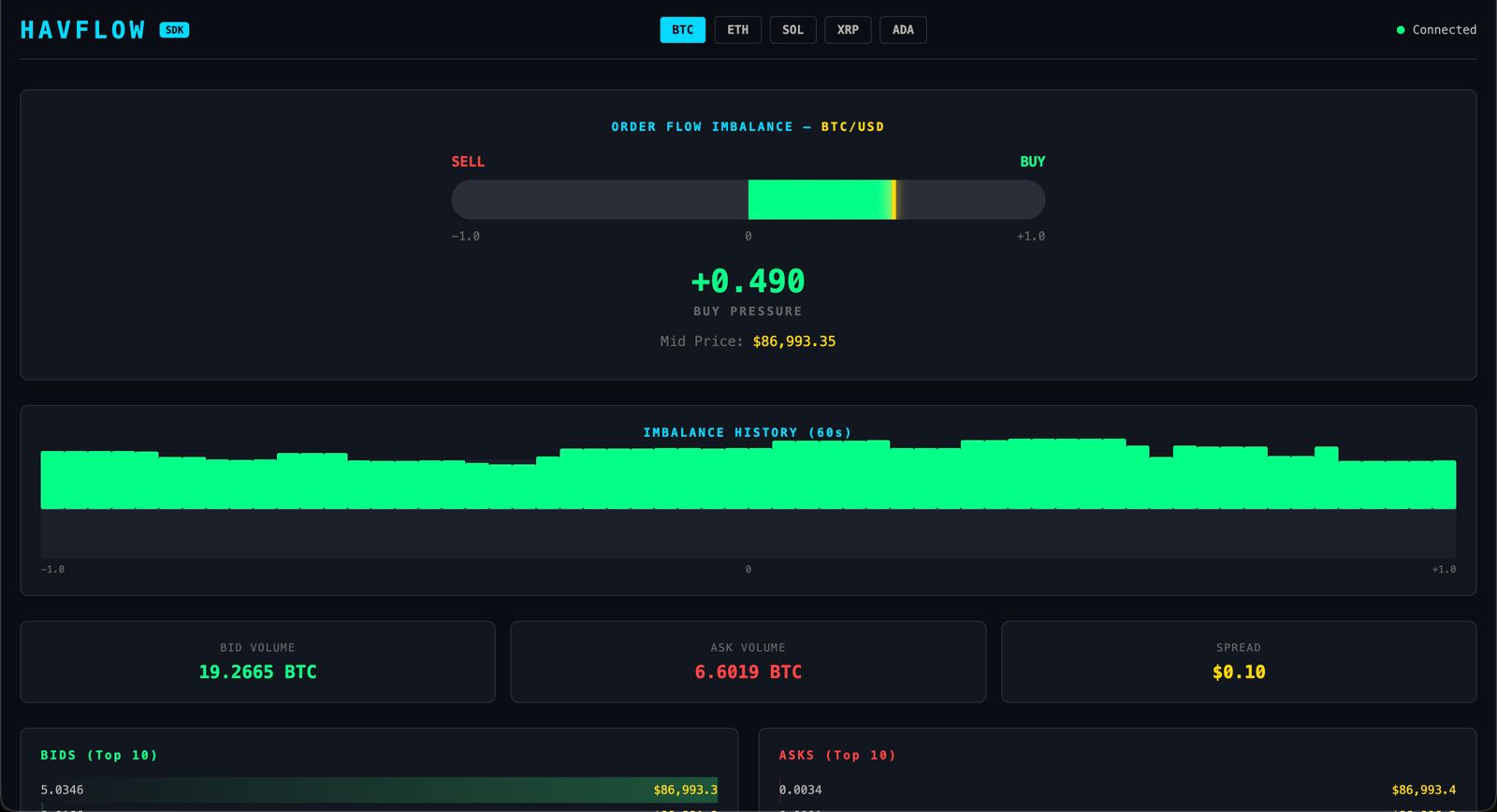
Havflow — Order flow analysis. Trade-by-trade visualization showing buy/sell aggression, trade clustering, and volume patterns. (Implementation Code)
Havnet — Multi-symbol dashboard. Monitor multiple trading pairs simultaneously, all running independent orderbook engines in the same browser tab. (Implementation Code)
Havwatch — Trade watcher and alert system. Monitor price movements, large trades, and orderbook imbalances with configurable notifications. (Implementation Code)
All five apps use the same kraken-wasm package that I am releasing as part of this SDK. They're not demos with mock data—they're connected to Kraken's live WebSocket feed right now.
Who Is This For?
Quantitative Traders — If you're building trading algorithms on Kraken, you need accurate orderbook data with minimal latency. Havklo gives you nanosecond lookups and cryptographic validation. Your strategies can trust the data.
Market Makers — L3 orderbook support means you can track queue position and optimize your quoting strategy. The fill probability estimation helps you balance aggressive vs. passive placement.
Application Developers — Building a trading dashboard, portfolio tracker, or analytics tool? The WASM module drops right into your JavaScript/TypeScript stack and gives you the same performance as native Rust.
Researchers — If you're doing market microstructure research, having accurate L3 data with proper validation is essential. Havklo captures order-level events with timestamps, queue positions, and market impact metrics.
Technical Stack
Language: Rust (2021 edition)
Async Runtime: Tokio
WebSocket: tokio-tungstenite
Serialization: serde with serde_json
Decimal Math: rust_decimal
WASM Toolchain: wasm-bindgen, wasm-pack
Total Lines of Code: ~23,000 (including tests and examples)
Getting Started
Add to your Cargo.toml:
[dependencies]kraken-sdk = "0.1"
Or for browser projects:
npm install @havklo/kraken-wasm
Full documentation with examples, API reference, and architecture guides: miny.mintlify.app
Links
GitHub Repository: github.com/hitakshiA/Havklo_sdk
Documentation: miny.mintlify.app
Live Demo (Orderbook): havsyn.vercel.app
Live Demo (Depth): havdepth.vercel.app
Live Demo (Flow): havflow.vercel.app
Live Demo (Multi-Symbol): havnet.vercel.app
Live Demo (Watcher): havwatch.vercel.app