Help Point
Turning natural disaster warnings into safe places to go. No one should flee to a full shelter.
- 0 Raised
- 24 Views
- 0 Judges
Team
Tags
Categories
Gallery
Description
💎 Idea
Help Point turns natural disaster warnings into safe places to go - because no one should flee to a full shelter. In 2025 alone, over 29.6 million people outside Europe were displaced by crises (IDMC, 2026). Although European Earth observation and open geospatial data are free, turning them into timely field action remains a major bottleneck. MIRA assessments take 72 hours for a first scenario and around two weeks for a full report, Copernicus EMS activations are restricted to authorised users, and professional GIS tools require specialist skills that discounts alone cannot remove. We do not believe every humanitarian organisation should have to become an Earth observation specialist - we work alongside them to turn existing knowledge into immediate action.
Built as a long-term, scalable venture, Help Point bridges the gap between area-level disaster forecasting and facility-level shelter management. Starting with UN agencies and disaster-response authorities before expanding to NGO programmes across the Global South, our clients combine satellite and local data to test what-if scenarios, evaluate shelter and hospital capacities, pinpoint critical shortfalls early, and plan assistance. For people affected by crises, finding safe facilities with reported available capacity will always remain free. Early feedback from an international aid worker confirmed that no comparable tool currently fills this operational gap. With a ~€25m global annual TAM, a ~€5m priority SAM, and a Year 3 SOM target of ~€1m, Help Point pairs lasting humanitarian impact with a sustainable business model.
🛰️ EU space technologies
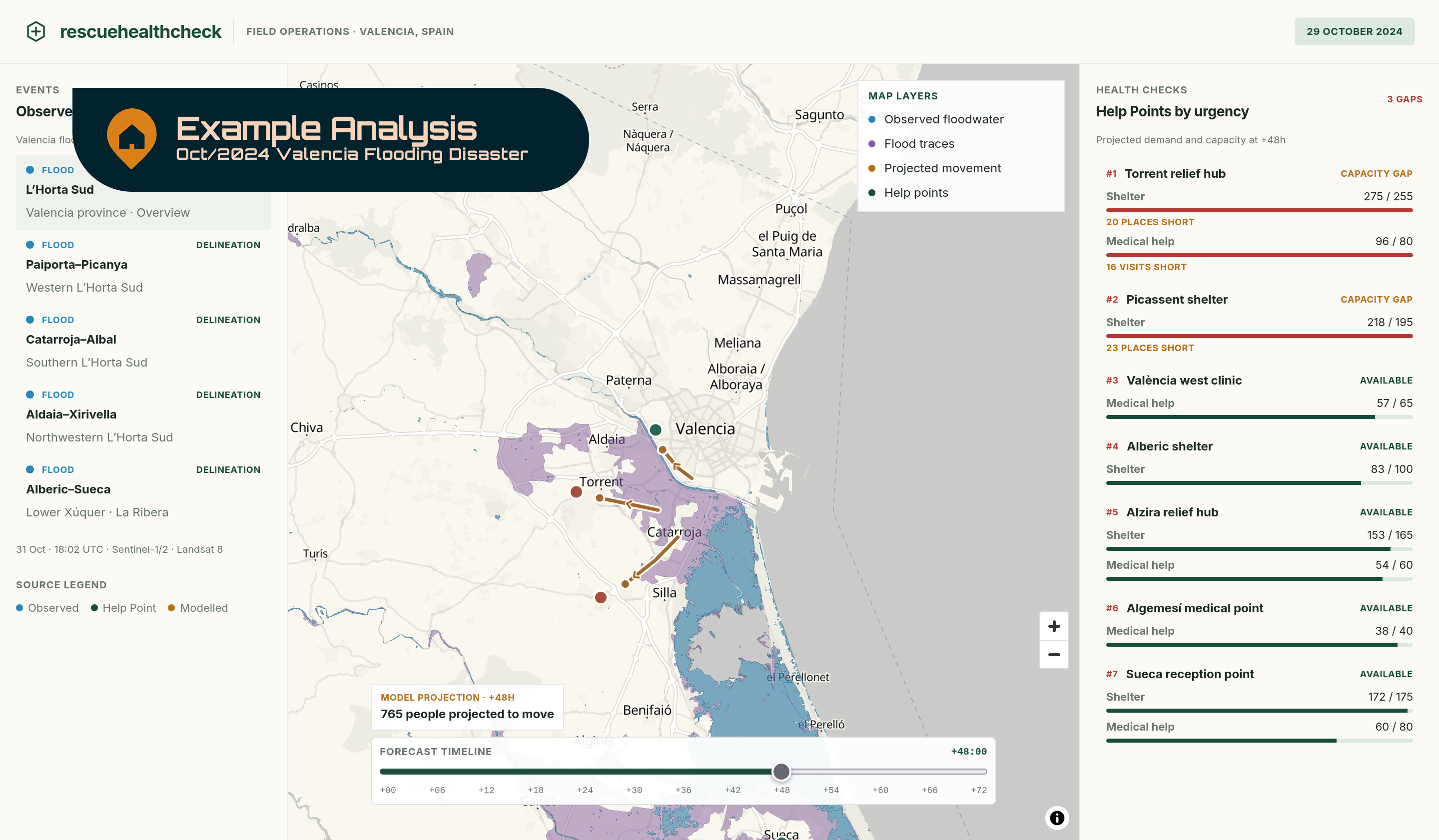
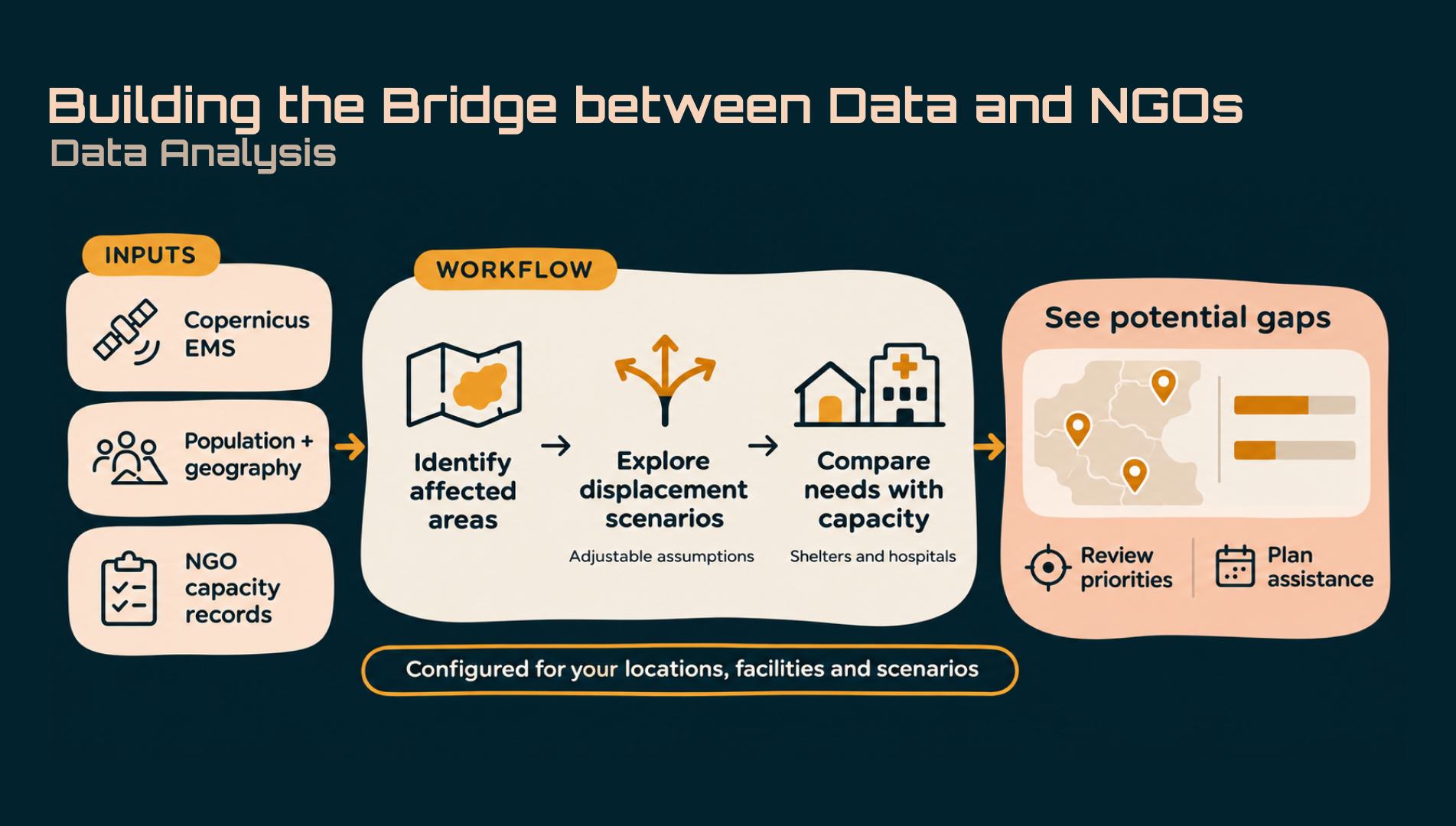
Help Point integrates Copernicus EMS outputs and open European satellite data with population distributions, transport networks, and locally supplied assistance point capacity records. Using the 2024 Valencia floods as a concrete test case, we worked with real Copernicus flood data to prototype an operational interface that identifies affected communities and models potential displacement. By comparing projected arrivals against locally reported capacities, the platform immediately reveals where humanitarian resources risk becoming insufficient.
Crucially, this flood workflow is just one possible pipeline. Through our reusable, modular building-block architecture, data integrations, analytical models, and their results can be shared and reconfigured across organisations, regions, and crisis scenarios without starting from scratch each time. This removes the GIS expertise barrier and turns EU space data into fast, tailored operational decisions.
🤼 Team
Our multidisciplinary team unites software engineering, data science, regional field expertise, and commercial strategy to build Help Point into a lasting organisation:
- Christian Bergschneider (Data Engineer): Experienced in data engineering and scalable pipelines, enabling reliable integration of complex geospatial and external datasets.
- Deyanira Borisova (Marketing Strategist): Leads positioning, communications, and outreach to build strong visibility and long-term partner engagement.
- Dr. Oliver Tackenberg (Data Scientist): Brings over 20 years of university research in database development and end-user tools in data science.
- Dr. Sascha Klement (Backend Engineer & Field Expert): Pairs strong backend engineering skills with deep regional familiarity in the Global South, language proficiency, and a cultural-historical research background.
- Vidas Pleta (Business Development): Drives commercial strategy, institutional partnerships, and sustainable growth across international organisations and public-sector buyers.
- Yacine Kacem (Fullstack Engineer): Specialises in end-to-end web development, translating complex technical workflows into accessible, resilient digital products.
- Yann Possmann (Fullstack & ML Engineer): Combines fullstack software development with machine learning expertise to create intelligent, user-ready applications and analytical tools.