GEO-QSEC
Location-authenticated key management for space-based secure comms: Galileo OSNMA-verified position and time gate release of QKD/PQC keys; AI trust scoring flags spoofing and moved nodes.
- 0 Raised
- 52 Views
- 0 Judges
Tags
Categories
Gallery




Description
💎 Idea
Europe is moving its most sensitive communications to space infrastructure: IRIS² for secure connectivity, EuroQCI for quantum key distribution and Galileo for position and time. All of them depend on cryptographic keys, and today's key management systems hand out keys based on identity alone. A captured terminal, a secretly relocated node or a receiver fooled by GNSS spoofing still receives valid keys.
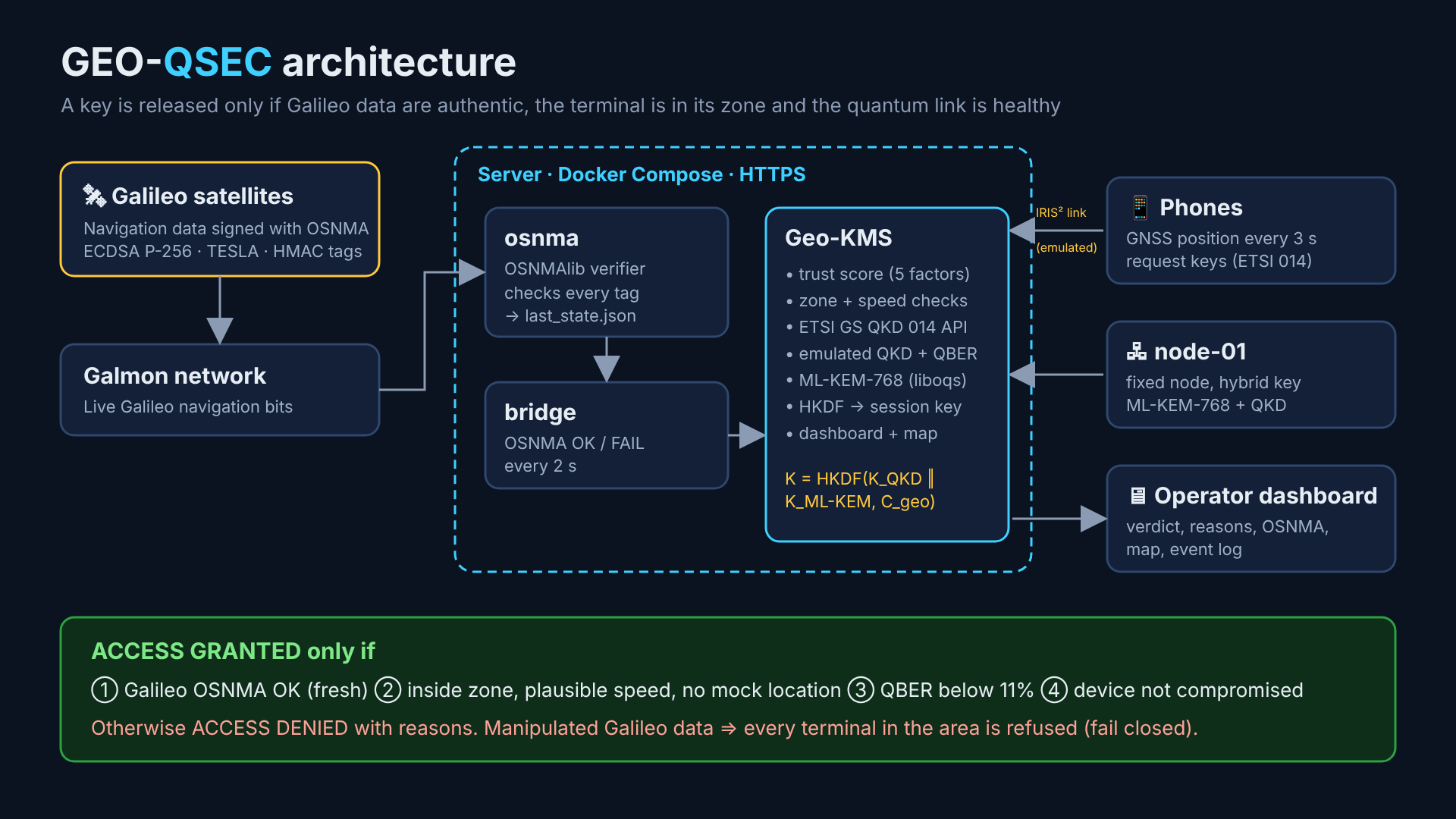
GEO-QSEC is a location-aware key management system (Geo-KMS). It releases a key only when:
- Galileo's Open Service Navigation Message Authentication (OSNMA) confirms that the navigation data in the area are genuine;
- the terminal is inside its authorised zone and moves plausibly;
- the quantum link is healthy (low QBER).
Each decision is a transparent trust score with plain-language reasons. Session keys are a hybrid of a QKD key and an ML-KEM-768 post-quantum secret, derived with HKDF and bound to the parties, the zone and a 5-minute time window. If the reference station detects manipulated Galileo data, all terminals in the area are refused (fail closed).
We demonstrate it live:
- normal operation;
- a phone leaving its zone;
- a fixed node being moved;
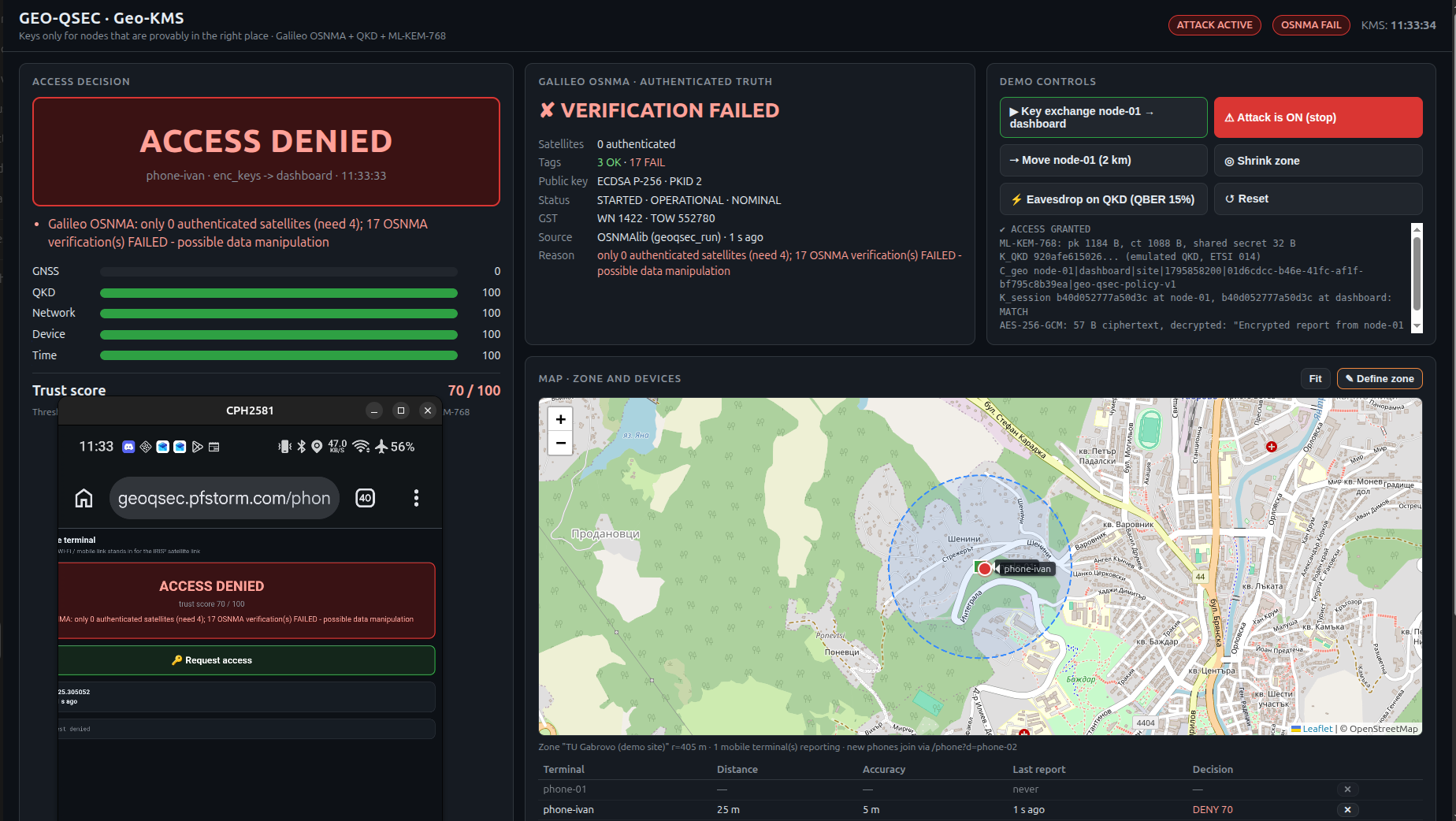
- an attack on Galileo navigation data, detected by OSNMA within about 60 seconds;
- eavesdropping on the QKD link.
Try it live:
- Operator dashboard (read-only for visitors): https://geoqsec.pfstorm.com/dashboard
- Join as a mobile terminal from your own phone: https://geoqsec.pfstorm.com/phone
The phone page asks for location permission. Phones inside the demo zone in Gabrovo get a key; everyone else is refused with the reason.
Github repo:
https://github.com/ivanasen99/geo-qsec?tab=readme-ov-file
Who it is for. Operators whose devices must stay where they belong:
- Energy and utilities: substation gateways and SCADA links. A stolen or relocated device never receives keys.
- Telecom and satellite ground segment: base stations, teleports, IRIS² user terminals. Keys are released only at approved sites.
- Defence and government: deployable terminals and embassies. A captured device is a dead device.
Why now. Under the EU coordinated roadmap for post-quantum cryptography, Member States define national plans by the end of 2026 and migrate high-risk use cases, including critical infrastructure, by 2030. Galileo OSNMA, our trust anchor, has been an operational service since July 2025 and is free to use.
Product and business model. GEO-QSEC is software with a standard interface: three containers, no new hardware, connected to existing encryptors through the ETSI GS QKD 014 API. It is sold three ways:
- an on-premises Geo-KMS with an annual licence per protected device;
- a managed Geo-KMS subscription for smaller operators;
- an OEM component for encryptor, HSM and KMS vendors.
Go-to-market: a 3-month pilot with one Bulgarian utility or telecom site, then a technology partnership with an encryptor or HSM vendor, then scale through EU programmes for secure connectivity and quantum communication infrastructure.
🛰️ EU space technologies
- Galileo OSNMA (core): live Galileo navigation data with OSNMA authentication, verified with the open-source OSNMAlib. That covers the ECDSA P-256 public key (Merkle tree anchored), the TESLA key chain and the HMAC-SHA-256 tags. This gives us an authenticated, free, Europe-controlled source of truth for position and time.
- Galileo positioning on terminals: phones report GNSS fixes (including Galileo) that are checked against the authorised zone, speed plausibility and mock-location flags.
- IRIS² (context): the Geo-KMS is designed for IRIS² governmental terminals. In the demo, mobile data stands in for the satellite link.
- EuroQCI (context): keys are delivered through the ETSI GS QKD 014 API used by QKD key managers, so the Geo-KMS can front real EuroQCI equipment.
Value: OSNMA turns Galileo from a positioning service into a security control. For the first time, the decision to release a quantum-safe key can depend on authenticated satellite data.
Challenge
We address Challenge 1, Cybersecurity for space-based strategic enablers:
- We validate signals: Galileo OSNMA authentication of every navigation message.
- We identify anomalies: manipulated navigation data, terminals outside their zone, impossible movement, relocated fixed nodes, QKD eavesdropping.
- We protect the keys that secure IRIS², EuroQCI and government networks, so that a compromised location means no key.
This directly strengthens the cyber-resilience of Europe's space-based communications and of the critical infrastructure that relies on them.
🤼 Team
- Ivan Kazanlakliev – Tech lead. Senior network solutions engineer (enterprise firewalls, VPN, SD-WAN), PhD student in Communication and Computer Engineering at TU Gabrovo. Built the OSNMA pipeline and the Geo-KMS.
- Kaloyan Tsankov – Product & Business Lead . PhD student in Communication and Computer Engineering at TU Gabrovo. Msci in AI.
- Deyvid Vasilev - Pitch & Market Research Lead . First-year Bachelor's student in Cybersecurity at TU Gabrovo.
- Krisi Georgieva – Frontend & UX Engineer . Bachelors student in Communication technologies and cybersecurity engineering at TU Gabrovo. GIS specialist at work.